
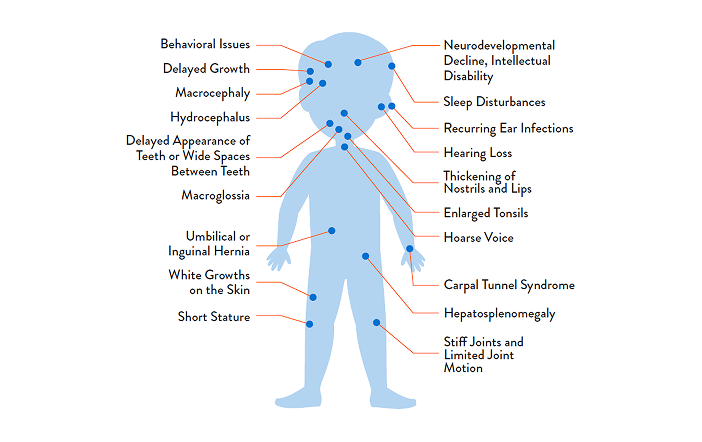
Hunter syndrome, also known as mucopolysaccharidosis type II (MPS II), is a rare genetic condition that impacts many parts of the body. It is considered a progressively debilitating condition, though the rate and severity of progression can vary.

The body relies on the enzyme iduronate-2-sulfatase (I2S) to help break down large sugar molecules called glycosaminoglycans, or GAGs. In people living with Hunter syndrome, a genetic mutation prevents their body from making I2S. As a result, GAGs accumulate inside the body’s cells, causing widespread symptoms that worsen over time.vi


Hunter syndrome affects the entire body, but its severity can range from attenuated (less severe) to neuronopathic (more severe) depending on the degree of brain involvement and cognitive impairment.vi
People with the attenuated form typically live into adulthood with minimal cognitive impairment, whereas people with the neuronopathic form experience severe neurodevelopmental decline and have a shortened life expectancy.vi

Treatment options for Hunter syndrome aim to address the deficiency of the I2S enzyme.vii,viii In the U.S., there are two approved enzyme replacement therapies for the treatment of Hunter syndrome.
Our pipeline includes an investigational gene therapy that is a one-time administration, designed to deliver a version of the gene responsible for I2S directly to CNS cells, potentially enabling long-term I2S production.iv The U.S. Food and Drug Administration (FDA) is reviewing comprehensive safety and efficacy to evaluate this gene therapy for potential regulatory approval.
We go beyond symptom management, providing patients with potentially disease-modifying
treatment options that could improve and extend quality time with loved ones.

Exon-skipping has the potential to treat Duchenne muscular dystrophy.

JAK1 inhibition is being developed to treat EGPA, a type of vasculitis.

Gene therapy has the potential to address critical genetic mutations, like those causing Hunter syndrome.
i MedlinePlus. Genetic Disorders. Available at: https://medlineplus.gov/geneticdisorders.html. Accessed December 2025.
ii MedlinePlus. What is Gene Therapy? https://medlineplus.gov/genetics/understanding/therapy/genetherapy/. Updated October 5, 2023. Accessed December 2025.
iii MedlinePlus. How Does Gene Therapy Work? https://medlineplus.gov/genetics/understanding/therapy/procedures/. Updated October 5, 2025. Accessed December 2025.
iv Data on File.
v Wraith JE, Scarpa M, Beck M, et al. Mucopolysaccharidosis type II (Hunter syndrome): a clinical review and recommendations for treatment in the era of enzyme replacement therapy. Eur J Pediatr. 2008;167(3):267-277. doi:10.1007/s00431-007-0635-4.
vi MedlinePlus. Mucopolysaccharidosis type II. https://medlineplus.gov/genetics/condition/mucopolysaccharidosis-type-ii/. Updated October 5, 2023. Accessed December 2025.
vii D’Avanzo F, Rigon L, Zanetti A, Tomanin R. Mucopolysaccharidosis Type II: One Hundred Years of Research, Diagnosis, and Treatment. Int J Mol Sci. 2020;21(4):1258. doi:10.3390/ijms21041258
viii Stapleton M, Kubaski F, Mason RW, et al. Presentation and Treatments for Mucopolysaccharidosis Type II (MPS II; Hunter Syndrome). Expert Opin Orphan Drugs. 2017;5(4):295-307. doi:10.1080/21678707.2017.1296761

